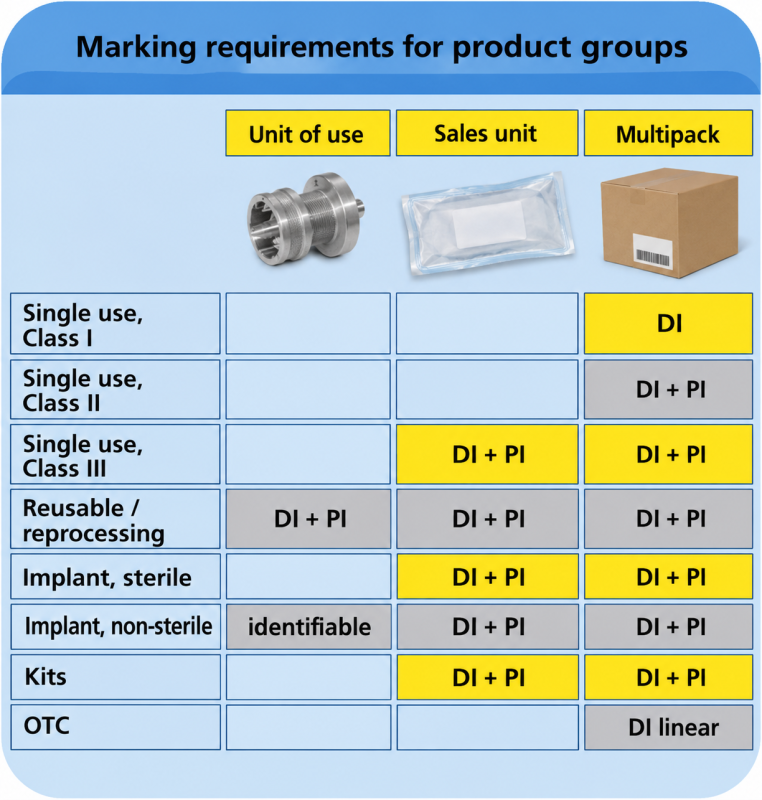
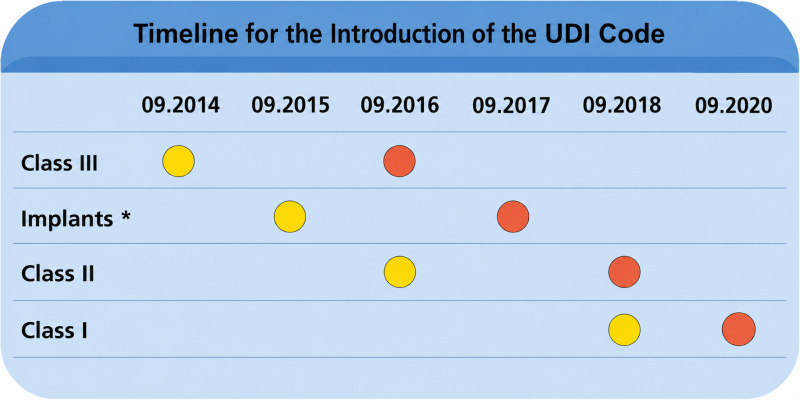
Medical device manufacturers that export to China are required to label their products in accordance with Chinese regulations and to register them in the Chinese medical device database “NMPA DB.” This requirement has been in effect for Class III medical devices since 2025, for Class II medical devices starting in February 2027, followed by Class I MDs. In collaboration with “ZIIOT,” a China-based standardization organization accredited for UDI, the EDCi team provides support for ZIIOT’s MA coding system, which offers the greatest possible flexibility in generating UDI codes for China. The term “MA code” derives from the leading characters “MA” in the UDI code, which correspond to the registered Issuing Agency Code for barcodes and RFID, “MA” (see REGISTER of ISSUING AGENCY CODES for ISO/IEC 15459:
https://www.aimglobal.org/wp-content/uploads/2025/03/Register-IAC-15459-2-20250331.pdf.
The key features of the MA code with benefits for medical device manufacturers are:
• UDI-compliant for China (in addition to GS1, ALIBABA – see https://www.e-d-c.info/september-2026-unique-devide-identification-udi-fuer-china/)
• The product reference in the system and on the label matches the product reference in the UDI code, up to 18 alphanumeric characters plus the
• Package index 0–9
• Convertible from HIBC UDI codes without changing master data
Standardized ISO/IEC codes, such as QR codes and DataMatrix, are commonly used as data carriers; the preferred code in China is the QR code.
Structure of the MA-UDI-Code
The MA code begins with the qualifier “MA.” followed by the country code of the labelers, residence, followed by the industry ID “M0” for medical devices, and the 6-digit company ID registered by ZIIOT upon request. After this header the product ID is next beginning with the package index, followed by the product reference. The UDI-DI part is terminated by a check digit.Then the Production Identifier (UDI PI) is following carrying the product attributes such as manufacturing date, expiration date, lot number, and or serial number. The attributes are each preceded by an MA-Data identifier (see Table 1). The data field separator is always a “period ( . )”.
For the whole structure see figure 1:
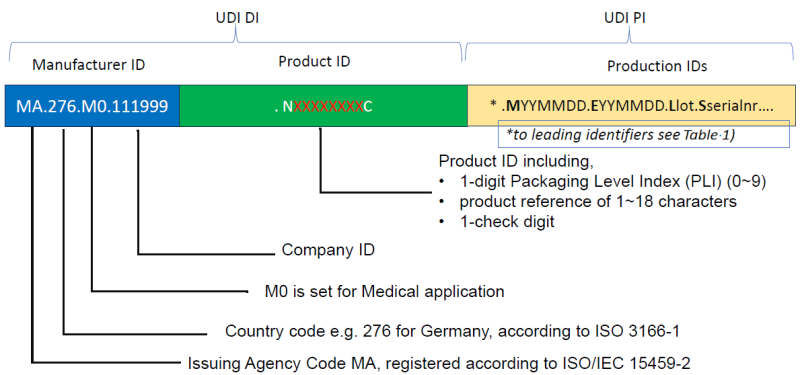
Table 1) MA-Data Identifiers for the product attributes in the UDI-PI portion of the UDI code.
MA-
Data Identifier | Name | Data format |
.M | Production date | YYMMDD |
.E | Expiration date | YYMMDD |
.L | Lot nr. (batch) | an…20 |
.S | Serial number | an…20 |
How to obtain a China-Compliant Manufacturer ID?
The China-compliant Manufacturer ID is a required field in the header of the MA code.
This ID (also known as the Company Identification Number—CIN) is registered upon request by ZIIOT, the accredited issuing agency for China. With the registered ID, the UDI code is uniquely identified within the Chinese system as originated from the specific labeling manufacturer. The application form is available on demand and will be send after an informal email to info@e-d-c.info applied with the subject line “MA Code ID Request”.
Example of a label applied with MA UDI Code
Figure 2 shows a China-compliant UDI code containing an 8-digit product reference, manufacturing date, and a lot number:
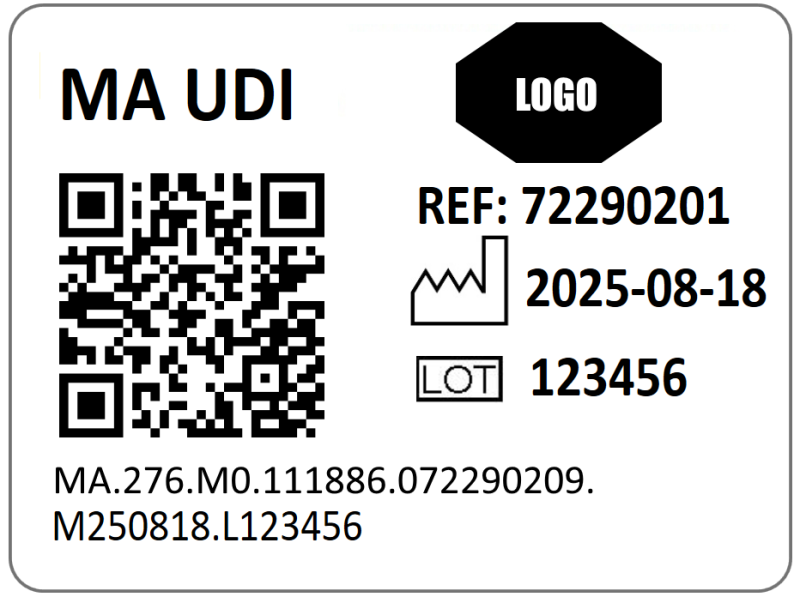
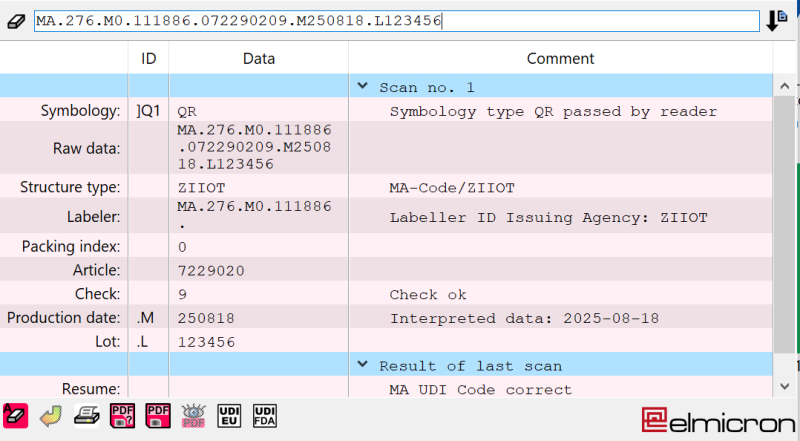
Figure 3 shows the scan analysis with the raw data encoded in the QR code and the extracted fields containing the product data:
Implementation of the MA Code
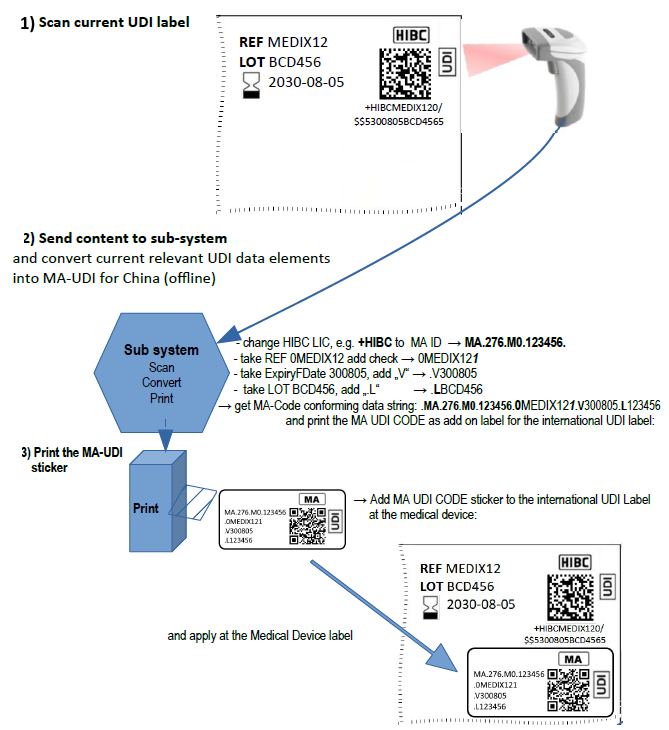
The MA code can be implemented in ERP systems or peripherally in downstream label printing systems. The structure of the MA code contains no control characters outside the standard keyboard character sets. For systems that already use other UDI structures, such as HIBC, a simple solution has proven effective: scanning the existing UDI code and converting the MA code from the contents of the existing code. See Figure 4) Scan & Print:

 UDI marking on the packaging
 UDI Kennzeichnung auf dem Produkt